

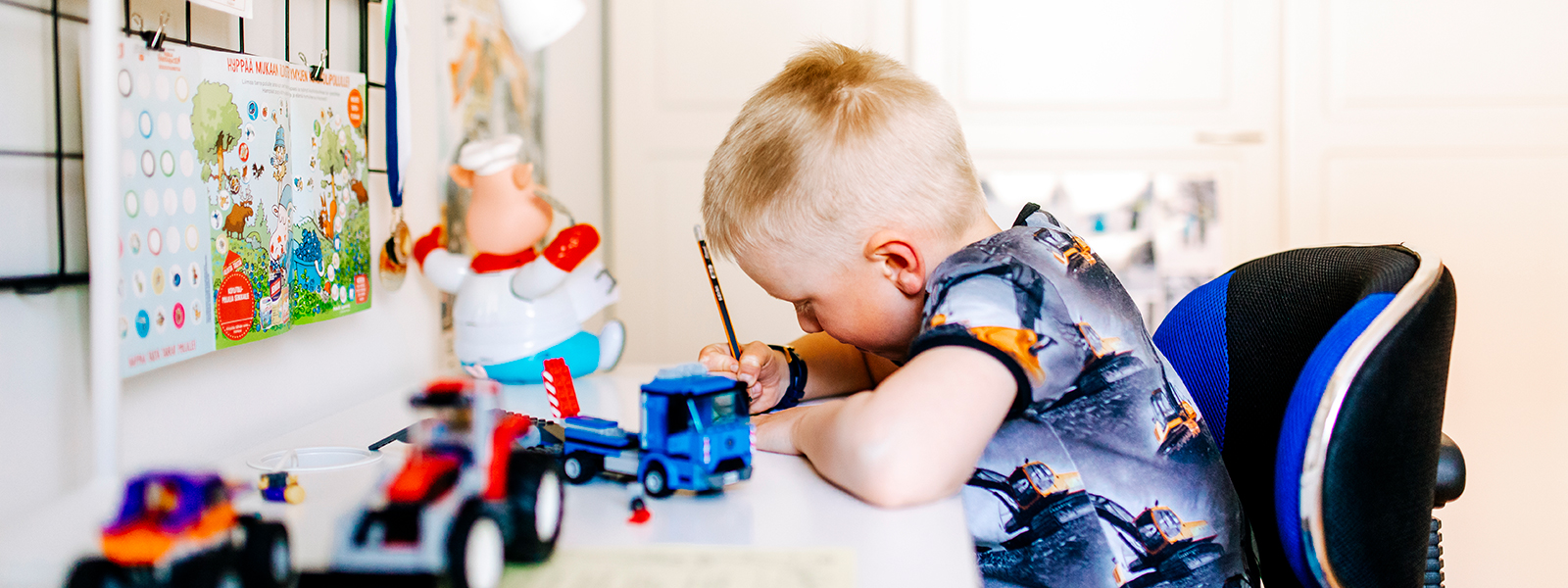
How to support a first grader’s learning
A child develops a realistic self-image when they realise they are learning new things and experience genuine success both on their own and with their family and other children. Parents should provide their child with opportunities to learn new things.
It is best to start practising new skills with activities that already come naturally to the child and, through these successes, gradually move on to more challenging skills. One the other hand, there is no need to fear failure, and a child’s abilities should not be compared to those of other children of the same age.
Learning through play is an essential part of early childhood. At school, the focus of learning shifts to conscious practice and studying. Show your child that you trust them to develop the necessary skills and abilities through practice and trying things out. Difficult things can be practised together, and not everything needs to be mastered straight away. The teacher also helps the child adjust to school life. It is the school’s and the teacher’s responsibility to make starting school as pleasant as possible and to create an inspiring learning environment in the classroom.
- Start learning a new skill at a level where your child is sure to learn it.
- Connect what you are learning to your child’s life in some way. Get excited about the skill yourself and make it interesting and fascinating.
- Pay less attention to failures. Give your child plenty of praise for making an effort and overcoming challenges. If your child puts themselves down, remind them that they are loved and already capable of doing many things.
- Explain that in order to learn and succeed, they need to practise and sometimes also fail. You can look back on when they were learning to ride a bike, swim or any other skill that they’ve already mastered.
- Remember that every day is different. If the child is tired or hungry or has other things on their mind, learning will not be easy. Say this out loud to your child: “Every day is different; let’s try again tomorrow when we’re not so tired.”
- Plan fun activities that you could do together after the child has completed a school task. Ice cream? A games night together? Watching a movie? After all the hard work, they can relax and enjoy the results of their efforts.
- Read to your child. Keep reading even when they can read for themselves.
- Get a library card and visit the library together to pick out books.
- Play with letters, words and numbers: make up rhymes, think of words that start with different letters, spot and count the number plates of passing cars, divide things (e.g. apples or playing cards) equally among family members…
- Let your child help with everyday tasks, such as writing the shopping list and reading recipes.
- Make doing homework a regular after-school afternoon routine that should not be skipped. The sooner homework becomes a routine, the better. One benefit of routines is that you do not have to think about whether to do homework or not every afternoon. When homework becomes a regular habit, the child’s internal resistance to doing it will decrease.
- If your child needs your help with their homework, make sure you set aside some time together. Help your child to break down the topic they need to learn into smaller sections. “First I’ll learn this part, then the next one, and only then the last section…”
- When helping your child, give instructions one at a time and ask them to repeat them. Long and complicated instructions are easy to forget, and it can be difficult for the child to understand the correct order in which to follow them.
- See if it is easier for the child to sit still if they can move around at suitable intervals or fidget with something in their hands.
The early stages of school clearly highlight the individual differences in children’s development and any learning difficulties they may have. Identifying barriers to learning as early as possible supports the child’s development and helps prevent other potential school-related problems, such as school refusal and school phobia.